


Alpine Slide and Summer Toboggan for Sale
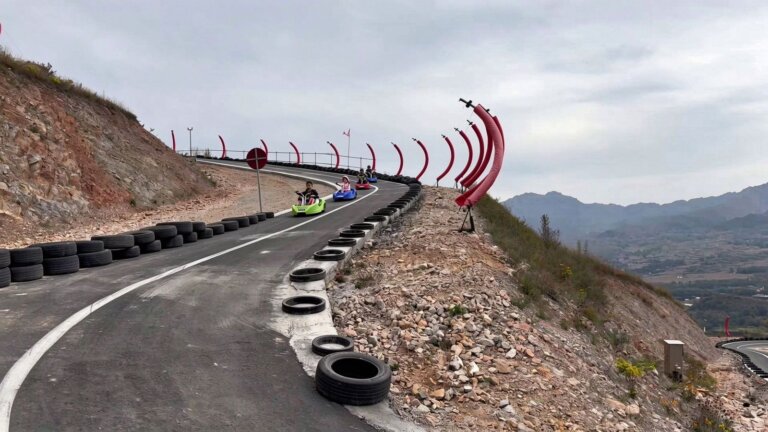
A surfaced track down a hillside with rider-controlled sleds — no snow, no rails above ground. Track length 600–1,500 m, vertical drop 40–150 m, capacity 250–1,000 sleds per hour depending on lane count and return system.
https://www.yuetonrides.com/wp-content/uploads/2026/10/mountain-slide-flume-768×432.jpg
1600 × 900
At a glance
- Surface types: concrete, polymer matting, epoxy coating or asphalt
- Slope 2%–35% overall; straights typically 8%–20%
- Track width 3–6 m, minimum radius 4 m at the centreline
- Roughly 12–16 m of ride per metre of drop — the number that decides whether a site works
- Return by conveyor, chain lift, tow or vehicle shuttle
What an alpine slide actually is
A road down a hill, a sled on it, and a way to get back up.
An alpine slide — also sold as a summer toboggan, mountain slide or dry luge — is a purpose-built descending track on the ground surface. The sled runs on the track under gravity, and the rider controls speed with a brake handle. There is no motor, no lift cable on the sled and no rail above the surface, which is why the product can be built on a slope that would never carry an elevated coaster.
That simplicity is the commercial argument. Civil works dominate the budget, the vehicles are cheap to replace, and a modest slope can produce a two-to-three-minute ride. It is also the reason quality varies so much between suppliers: the track is only as good as its drainage, its joints and its radius discipline, and none of those show up in a photograph.
Two ways to build one: on the ground or on a rail
The same rider experience, two very different structures.
A ground track follows the terrain. The sled runs on a prepared surface, and the profile is the hill’s profile — cut, filled and drained to a design gradient. Cost per metre is low, the visual impact is small, and the track can be built with local plant. The constraint is the terrain itself: you cannot make a ground track steeper than the slope allows, and you cannot cross a gully without filling it.
A rail-guided version — sold internationally as an alpine coaster or mountain coaster — carries the same sleds on a steel tube track supported above the ground. It can climb, cross a ravine, bank through a curve tighter than the terrain permits, and run in both directions from a single station. Cost per metre roughly doubles, and the structure has to be engineered for wind and snow load. On a site with a usable fall line, the ground track usually wins on payback; on broken terrain or where the return line has to cross an obstacle, the rail version is often the only way to get the length.
Surface slide
Concrete, polymer or coated asphalt. Lowest capital cost, quickest to build, needs good drainage and a disciplined gradient.
Rail-guided coaster
Steel tube on supports. Crosses obstacles, banks curves, handles tighter turns. Roughly double the cost per metre.
The number that decides the site
Ride length per metre of drop — before any drawing is made.
On a well-built surface slide, one metre of vertical drop gives roughly 12 to 16 metres of ride, depending on gradient, curve count and how hard the rider brakes. That ratio is the fastest way to answer the question every client asks first: how long a track can I get?
A 60 m drop therefore supports roughly 720–960 m of track — enough for a two-minute descent. A 40 m drop gives 480–640 m, which is a shorter ride and usually needs a steeper average gradient to feel worth the ticket. Below about 30 m of usable drop, a surface slide rarely justifies the civil works, and a compact rail layout or a different product altogether makes better commercial sense. Working this out takes a topographic map and ten minutes, and it saves both sides a wasted feasibility study.
Track geometry that riders feel
Three numbers separate a slide that runs smoothly from one that rattles.
| Parameter | Typical value | What it controls |
|---|---|---|
| Minimum radius | > 4 m at the centreline | Tighter radii force riders to brake, which lengthens the queue and shortens the ride. |
| Curve banking | Around 10%, low inside to high outside | Banking lets a curve be taken at speed. A flat curve at the same radius feels unsafe and gets braked. |
| Joint and surface continuity | No step at any joint | Steps and lips are what riders describe as vibration. They also wear tyres and brake pads faster. |
Technical specification
Indicative ranges. Final values are fixed with the alignment drawing.
| Parameter | Typical range | Notes |
|---|---|---|
| Track length | 600–1,500 m | Along the centreline, station to run-out |
| Vertical drop | 40–150 m | Top station to finish |
| Overall slope | 2%–35% | Straights typically 8%–20% |
| Track width | 3–6 m | Widened at curves and stations |
| Minimum radius | > 4 m | Measured at the centreline |
| Curve banking | ~10% | Inside low, outside high |
| Side barrier | 1.2 m | Plus impact strip at ground level |
| Running speed | 10–20 km/h | Rider-controlled; average nearer 10 |
| Ride per metre of drop | 12–16 m | Gradient and curve dependent |
| Sled payload | 150–350 kg | Single or tandem configuration |
| Braking | Dual disc, handle lever | Bicycle-type lever, both rear wheels |
| Lead time | 30–150 days | From approved drawings to shipment |
| Installation | 60–120 days | After civil works; weather dependent |
Surface choice
Four options, and the maintenance each one commits you to.
| Surface | Best for | Commitment |
|---|---|---|
| Concrete | High traffic, long season | Highest build cost, lowest annual maintenance. Joints must be ground flush. |
| Polymer matting | Ride comfort, moderate traffic | Smooth and quiet, but panels lift at edges and need periodic re-fixing. |
| Coated asphalt | Fast build on an existing road | Cheapest to lay. Softens in heat, so it needs an annual check and re-levelling. |
| Epoxy coating | Retrofit onto sound concrete | Good grip when wet, but wears through on braking zones. |
Getting riders back up
The return system sets real capacity more often than the track does.
A slide has to return its sleds to the top, and that loop is where queues come from. Four options, in ascending cost: vehicle shuttle (a trailer towed up the access road — cheapest, but slow and labour-heavy), chain lift (reliable on short, straight alignments), tow or cable lift (longer runs, needs a maintained line), and conveyor (continuous, best rider experience, highest capital cost).
The practical rule: match return capacity to about 120% of track capacity, not to the peak day. If the return system is the bottleneck, the queue forms at the bottom of the hill where everyone can see it, and the ride feels half as long as it is.
Typical configurations
Three sizes, from a single hill to a destination attraction.
| Site | Track length | Drop | Slope | Lanes | Capacity |
|---|---|---|---|---|---|
| Small hill park one slope, summer season | 500–800 m | 40–60 m | 8%–15% | 1 | 250–400 pph |
| Mountain resort existing access road | 800–1,200 m | 60–100 m | 10%–20% | 1–2 | 400–700 pph |
| Destination attraction long fall line, high footfall | 1,200–1,800 m | 100–150 m | 10%–25% | 2 | 700–1,000 pph |
Capacity is set by the return system as much as by the track. A second lane without a matching lift simply moves the queue.
Safety and compliance
What we can state, and what depends on your jurisdiction.
The sled carries a dual disc brake on both rear wheels, operated by a handle lever, plus a safety harness where the local regime requires one. The track has a 1.2 m side barrier and a ground-level impact strip at curves and long descents; stations are fenced and staffed. Helmet provision is standard on our installations.
Regulatory treatment varies by country — a surface slide is classified as an amusement device in some markets and as a sports facility in others, and the inspection body changes with the classification. We confirm the applicable standard with you at feasibility stage and state in the contract exactly what documentation we provide and what the local authority must approve. We do not list certificates that may not apply to your market.
Cost and schedule
Four lines, and the one that usually surprises people.
Budget splits into track and surface, sleds and return system, civil works, and freight. The track surface is the line clients underestimate: concrete on a prepared formation is one number, and concrete on a slope that needs benching, drainage and retaining is another entirely. That civil figure is also the reason we survey before quoting — the same 800 m alignment can differ by a factor of two across two hills.
We do not publish a headline price for the equipment line, because two sites with the same track length can differ by a factor of two on earthworks and drainage. What we do issue before the survey is a budget band with its assumptions written down, so it can be checked rather than guessed at.
Installation and after-sales
Who is on site, and what happens after handover.
Installation and commissioning are carried out by our own engineering team: formation check, surface laying, joint grinding, barrier and impact strip fixing, sled fleet assembly and brake adjustment, then loaded test runs. Operator training covers dispatch discipline, speed monitoring and the daily brake check. A spare parts package covers the wear items — brake pads, tyres, harnesses and barrier sections.
Maintenance is mostly surface and brake: an annual joint inspection, drainage clearing before the wet season, brake pad replacement on running hours rather than calendar, and a tyre check that depends on whether the fleet runs solid or pneumatic tyres. Solid tyres last longer but demand a flatter surface; pneumatic tyres ride better and need more frequent pressure checks.
Related scenic-area equipment: glass water slides the wet alternative on the same slope, rail slides where the terrain will not carry a surface track, rainbow dry slides the low-cost entry version, funiculars and magic carpets so guests do not walk back up. A single site survey can cover all of them, because the survey work is the same.
Frequently asked questions
What is the difference between an alpine slide and an alpine coaster?
An alpine slide runs on a surfaced track on the ground; an alpine coaster carries the same sleds on a steel tube track supported above the ground. The coaster can cross obstacles and bank tighter curves, and costs roughly twice as much per metre. On a clean fall line, the surface slide usually pays back faster.
How long can an alpine slide be?
Length follows the drop. At roughly 12–16 m of ride per metre of drop, a 60 m hill supports 720–960 m of track and a 100 m hill supports well over a kilometre. Reference range for the product: 600–1,500 m.
What slope does it need?
An overall gradient between 2% and 35%, with straights usually falling between 8% and 20%. Below roughly 30 m of usable drop the civil works rarely justify the build; above 35% average the ride becomes hard to control and needs more braking zones.
How much does an alpine slide cost?
Four lines: track and surface, sleds and return system, civil works, freight. Civil works is the variable that moves most — benching, drainage and retaining on a rough slope can approach the track cost. We issue a budget band with written assumptions before the survey and a firm quotation after it.
How do riders get back to the top?
Either a conveyor, a chain or cable lift, a tow, or a vehicle shuttle on the access road. The practical rule is to match return capacity to about 120% of track capacity — if the lift is the bottleneck, the queue forms at the bottom where every guest can see it.
Can it operate in rain?
Light rain is workable with the right surface and brake specification; heavy rain is not, because braking distance changes and riders cannot judge it. Most operators close during downpours and reopen after the surface drains, which is why drainage design is part of the track design rather than a civil afterthought.
Which surface should the track use?
Concrete for high traffic and long seasons, polymer matting for ride comfort, coated asphalt for a fast build on an existing road, epoxy coating for a retrofit onto sound concrete. Each commits you to a different maintenance routine, and the choice should follow traffic volume rather than budget alone.
How long does installation take?
Roughly 60–120 days on site after the formation is ready, depending on track length, surface type and weather. The formation is the critical path: the track cannot be laid until drainage and benching are finished, and a wet season in the middle of that work moves everything.
Send us the slope, we will send back the length
A topographic map and your usable drop are enough for a first answer: how much track the site supports, what the ride feels like, and which return system pays for itself.