


Rainbow Slide and Dry Slide for Sale
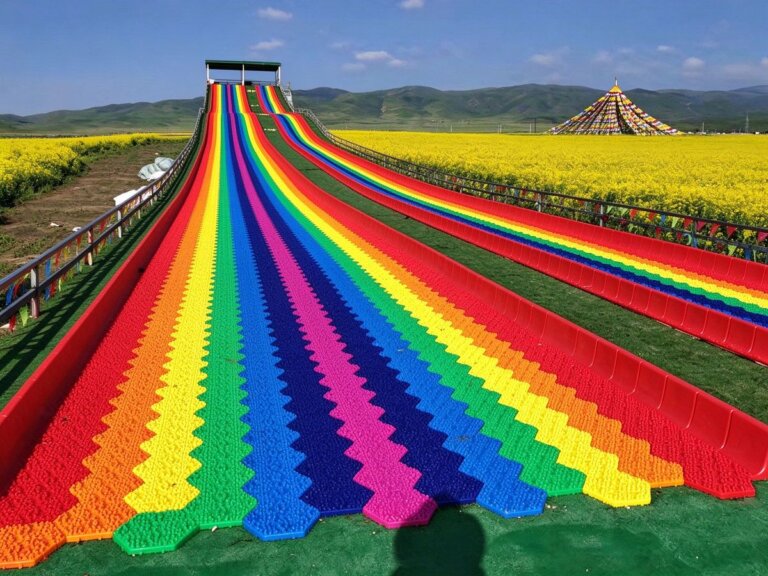
A multi-coloured slide built down a grass slope, ridden on a ring or a mat. Run length 50–300 m, three to eight lanes, gradient 20°–35°. It is the cheapest paid attraction you can add to a hillside, and the fastest to open — most installations are on site for two to six weeks.
https://www.yuetonrides.com/wp-content/uploads/2026/10/rainbow-slide-flume-768×576.jpg
1600 × 900
At a glance
- Three to eight parallel lanes, each 0.6–1.0 m wide
- Run length 50–300 m, gradient 20°–35°
- Material: glass-reinforced plastic (FRP) panels or polymer slide boards
- Ridden on a ring or mat — no vehicle, no track, no power
- Fastest product in this range to open: 2–6 weeks on site
What it is, and what it is not
It looks like an alpine slide and behaves nothing like one.
A rainbow slide is a set of coloured panels laid on a prepared slope, forming parallel chutes. The rider sits in a ring or on a low-friction mat and slides down under gravity, steering nothing and braking with their feet. There is no track structure, no vehicle and no lift: the ride is the slope, dressed in colour.
That makes it the entry-level product of the category. An alpine slide needs a prepared road-width track, sleds, brakes and a return system; a rainbow slide needs a graded slope, panels, a landing zone and someone at the top to dispatch. The capital difference is roughly an order of magnitude, and so is the build time. What you give up is length, speed control and the ability to run in the rain.
| Rainbow slide | Alpine slide | |
|---|---|---|
| Ridden on | Ring or mat | Wheeled sled with brake |
| Structure | Panels on graded ground | Surfaced track, drainage, barriers |
| Gradient | 20°–35° | 2%–35%, with radius discipline |
| Return system | Guests walk up | Lift, tow or shuttle |
| Relative capital cost | Lowest | Several times higher |
| Build time | 2–6 weeks | 2–4 months |
| Wet weather | Closes | Runs, with care |
Why it earns its place
Not as a headline attraction — as the thing that makes a site worth a ticket.
Judged against a coaster, a rainbow slide is unimpressive. Judged against an empty hillside, it is a paid attraction that opens in a month, employs two people and photographs extremely well. That combination is why it appears so often in Chinese scenic areas and family parks: it converts unused ground into revenue without a multi-year approval cycle.
It also does something a bigger ride cannot. It brings families with young children, who are the highest-frequency repeat visitors on any site, and it gives them a reason to stay an extra hour. On a site whose main attraction is a walking trail, that extra hour is the entire business case.
Our honest view on how to buy it: as a package with something longer. A rainbow slide on its own competes on price with every local fabricator. A rainbow slide plus an alpine slide or a themed uphill ride gives visitors a half-day circuit and gives you a reason to charge for the day rather than the ride.
Configurations
Lane count does the work; length is limited by the slope, not the product.
Compact
For a small park or a hotel hillside. Low cost, one attendant, and enough capacity for a few hundred guests a day.
Standard
The usual scenic-area specification. Racing between lanes is the draw, and throughput covers a busy weekend.
Wide
Where the bottom landing area is generous and the queue is expected to be long. Needs a wider slope and more attendants.
Straight or stepped
Straight runs are faster. Stepped or kinked layouts slow riders and let the slide follow a slope that is not a clean plane.
Technical specification
Indicative ranges. Final values follow the slope survey.
| Parameter | Typical range | Notes |
|---|---|---|
| Run length | 50–300 m | Follows the available slope, not a catalogue |
| Gradient | 20°–35° | Below 20° riders stall; above 35° speed control becomes the issue |
| Lane width | 0.6–1.0 m | Wider lanes suit adults and tandem rings |
| Lane count | 3–8 | Throughput scales with lanes, not with speed |
| Panel material | FRP or polymer board | FRP holds colour longer; polymer is easier to replace in sections |
| Guard | Side kerb or rail, full length | Non-negotiable; most incidents are lane departure |
| Landing | Flat run-out, 8–15 m | Sized for the fastest rider, not the average |
| Capacity | 200–600 riders per hour | Depends on lanes, dispatch discipline and walk-up time |
| Lead time | 30–50 days | From confirmed dimensions to shipment |
| Installation | 2–6 weeks | Site preparation is usually the longer half |
Site requirements
The slope does most of the work, so the slope has to be right.
| Requirement | Why it matters |
|---|---|
| Clean continuous slope | A dip or a bump turns into an airborne rider. The ground has to be graded before panels go down. |
| Drainage | Water under the panels softens the base and lifts them. Cross-slope drainage matters more than the panels themselves. |
| Flat landing area | Run-out length is set by the fastest rider. A short run-out into a fence is the most common design error. |
| Walk-up route | Guests carry the ring back up. If the walk is long or steep, capacity and satisfaction both drop. |
| Shade or orientation | Dark panels in direct sun reach uncomfortable temperatures. Orientation and colour both affect this. |
Material and maintenance
Two materials, two different five-year stories.
FRP panels are moulded with the colour in the resin, so they hold their appearance for years and take wax well. They are stiff, they do not deform under a rider, and they are repaired by patching — which works but never looks invisible. Polymer boards are lighter, cheaper per lane and easier to replace one at a time, but they chalk and fade in UV and the joints move more with temperature.
Either way, the maintenance that matters is waxing and joint inspection. A waxed lane is fast and predictable; an unwaxed one is slow at the top and fast at the bottom, which is exactly the wrong way round for safety. Joints should be checked weekly in the first season, because a lifted edge is both a trip hazard and a launch ramp.
Safety and operation
Low speed does not mean low risk — it means the risks are different.
The recurring incidents on this product are lane departure, riders entering before the lane is clear, and riding position — head first, or two riders sharing a ring built for one. All three are managed by operation rather than by engineering: one dispatcher per two to three lanes, a clear signal system, a posted riding position, and a hard rule that the lane is not released until the previous rider has cleared the run-out.
Wet weather closes the ride. It is not a comfort decision: water on the panels changes friction unpredictably and a rider can arrive at the landing faster than the operator expects. Most sites treat rain closure as a fixed operating rule rather than a judgement call, which is both safer and easier to defend.
Cost and schedule
Cheap to buy, and cheaper still if the slope already exists.
Budget splits into panels and guards, ground preparation, landing area, and installation. On a slope that is already graded and drained, the equipment is most of the cost and the project is quick. On a raw hillside, ground preparation can exceed the panels — which is why we ask for a slope survey before quoting, and why the honest answer to “how much” depends entirely on how much earthworks your site needs.
We do not publish a headline price, because the ratio between equipment and site work varies so widely. What we do is quote them separately, so you can see which half of the project you are actually buying.
Typical configurations
Three sizes that cover most sites.
| Site | Run length | Lanes | Gradient | Capacity |
|---|---|---|---|---|
| Hotel or small park one slope, family audience | 50–80 m | 3–4 | 22°–28° | 200–300 pph |
| Scenic area main family attraction | 100–180 m | 5–6 | 25°–32° | 350–500 pph |
| Large park high footfall, wide slope | 200–300 m | 7–8 | 28°–35° | 500–600 pph |
Where it fits in a circuit
Best bought with something longer, not on its own.
A rainbow slide works hardest when it is the easy, cheap, always-available option next to a bigger ride. Guests who will not queue for an alpine slide will still take a ring down a 120 m slope, and families with toddlers use it while older children are elsewhere on the site.
Related scenic-area equipment: alpine slides the longer, braked version, rail slides where the ground is broken, funiculars and magic carpets to bring guests back up without the walk, glass water slides for a summer signature attraction. A single site survey can cover all of them, because the survey work is the same.
Frequently asked questions
What is a rainbow slide?
A multi-lane dry slide built down a prepared grass or soil slope, using coloured FRP or polymer panels. Riders sit in a ring or on a mat and slide down under gravity. There is no vehicle, no track structure and no lift.
How is it different from an alpine slide?
An alpine slide carries riders on wheeled sleds on a surfaced track, with brakes and a return system, and costs several times more. A rainbow slide is panels on graded ground, ridden on a ring, with guests walking back up. It is cheaper and faster to build, and it closes in rain.
How much does a rainbow slide cost?
Panels and guards, ground preparation, landing area, installation. On an already graded slope the equipment dominates. On a raw hillside, ground preparation can exceed the panels, so we quote the two halves separately.
How steep does the slope need to be?
Between 20 and 35 degrees. Below 20 degrees riders stall before the bottom; above 35 degrees speed control at the landing becomes the governing problem.
How many lanes should we build?
Throughput comes from lanes, not speed. Three to four lanes suits a hotel or small park, five to six is the usual scenic-area specification, and seven to eight is for high footfall with a wide slope and a generous landing area.
Can it run in the rain?
No, and the closure should be a fixed rule rather than a judgement call. Water changes friction unpredictably and riders can arrive at the landing faster than the operator expects.
How long does it last?
FRP panels with colour moulded into the resin hold their appearance for many years and are repaired by patching. Polymer boards are cheaper and easier to replace individually, but chalk and fade under UV and move more at the joints with temperature.
How fast can it open?
Thirty to fifty days for manufacture and two to six weeks on site. Site preparation is usually the longer half; on a slope that is already graded and drained, the whole project can be under two months.
Send us the slope, we will send back a lane layout
Slope length, gradient and the width at the bottom are enough for a first proposal: lane count, run length, and an indicative split between equipment and site work.