


Rail Slide and Tube Rail for Sale
A stainless steel tube track carried on posts, with individual sleds running down it under gravity. Track length 200–800 m, vertical drop 20–100 m, capacity 150–400 riders per hour. The lowest capital cost of any guided descent — and the fastest to build.
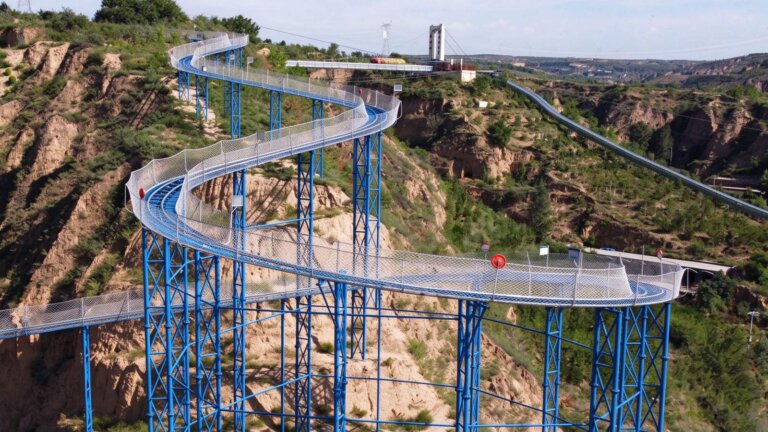
https://www.yuetonrides.com/wp-content/uploads/2026/10/rail-slide-flume-768×432.jpg
1600 × 900
At a glance
- Twin stainless steel tube track on steel or concrete posts
- Material: 304 standard, 316 for coastal or high-humidity sites
- Slope 8%–20%; gravity-driven, no lift cable on the sled
- Minimum curve radius 3–5 m, with banking through bends
- Post spacing 3–6 m on independent footings
- Braking: rider hand brake, or magnetic retarder on steeper runs
What a rail slide is
A tube track on legs, a sled that hooks onto it, and gravity doing the rest.
A rail slide — also called a tube rail or stainless slide — is a pair of parallel steel tubes carried on posts a short distance above the ground. The sled engages the tubes through a carriage, so it cannot leave the track, and the rider controls speed with a brake lever. Because the track is a structure rather than a surface, the alignment does not have to follow the ground: posts can be longer at a dip, shorter on a rise, and the profile stays smooth where the terrain is not.
That is the whole commercial case. Compared with a surfaced alpine slide, the rail version avoids most earthworks and drainage — you build small footings instead of benching a hillside — and it can cross a gully, a service road or a stand of trees without cutting through them. Compared with an alpine coaster, it carries one or two riders per sled instead of a train, runs at lower speed, and costs a fraction per metre. It sits between the two, and on a mid-sized site with an awkward slope that is usually the right place to sit.
Three ways down a hill — pick by terrain, not by taste
The comparison that decides most projects before a drawing exists.
| Rail slide | Surface alpine slide | Alpine coaster | |
|---|---|---|---|
| Structure | Steel tubes on posts | Prepared ground surface | Steel tubes on posts, heavier section |
| Capital cost per metre | Low | Lowest on a clean slope | Highest |
| Terrain it tolerates | Broken slope, gullies, trees | Continuous clean fall line | Anything, including crossings |
| Civil works | Small footings | Extensive — benching and drainage | Footings plus heavy supports |
| Speed | Moderate, rider-controlled | Moderate, rider-controlled | High, largely track-controlled |
| Capacity | 150–400 pph | 250–1,000 pph | 300–800 pph |
| Best fit | Mid-size site, irregular ground | Budget-led project, good fall line | Destination attraction |
Capacity figures assume a matched return system. Adding sleds without adding return capacity moves the queue, not the throughput.
Track and structure
Four numbers decide whether the ride feels smooth or rattles.
| Parameter | Typical value | What it controls |
|---|---|---|
| Track gauge and tube size | Matched to the sled carriage | Gauge sets stability; undersized tube flexes and the sled feels loose. |
| Minimum radius | 3–5 m | Tighter than a coaster, but below 3 m riders brake through every bend. |
| Curve banking | Built into the post heights | Banking lets a bend be taken without braking. It is set at fabrication, not on site. |
| Post spacing | 3–6 m | Wider spacing means deeper tube section and heavier footings — cheaper posts, dearer steel. |
Technical specification
Indicative ranges. Final values are fixed with the alignment drawing.
| Parameter | Typical range | Notes |
|---|---|---|
| Track length | 200–800 m | Along the centreline, station to run-out |
| Vertical drop | 20–100 m | Top station to finish |
| Slope | 8%–20% | Gravity-driven; below 8% the sled stalls on damp track |
| Track material | 304 or 316 stainless | 316 for coastal, industrial or high-humidity sites |
| Tube wall thickness | Per structural calculation | Wear allowance on the running surface is part of the design |
| Support | Galvanised steel posts on concrete footings | Frost depth governs footing size in cold climates |
| Sled | Single or tandem | Carriage engages the tubes; rider operates a hand brake |
| Braking | Hand brake; magnetic retarder optional | Retarder recommended above roughly 15% sustained grade |
| Capacity | 150–400 pph | Depends on sled count, dispatch interval and return system |
| Lead time | 30–150 days | From approved drawings to shipment |
| Installation | 45–90 days | After footings cure; weather dependent |
Foundations and the one thing that ruins them
Short posts still need real footings.
Because the track sits low, it is easy to assume the foundations are trivial. They are not. Each post carries a share of the track, the sled and the rider, and the loading is dynamic — every sled passing puts a cycle through the footing. On a slope, the governing case is usually uplift on the uphill side rather than compression on the downhill side, which is why footings are designed as anchors and not just as pads.
Two site conditions cause most of the problems we see on existing installations. The first is frost: a footing above the local frost depth will lift, and the track will show a step within one or two winters. The second is surface water: a slope that sheds water across the alignment will scour the footings and undermine them. Both are cheap to solve at design stage and expensive to correct afterwards, which is why we ask for soil and drainage information before fixing the alignment.
Braking
Rider-controlled is standard. Above a certain grade, it stops being enough.
On gentle alignments, a hand brake on the sled is sufficient and gives riders the feeling of control that sells the experience. As sustained grade rises, hand braking becomes a fatigue and compliance problem: riders brake late, brake unevenly, and the second half of the track becomes a series of stops. Above roughly 15% sustained grade we specify a magnetic retarder that caps top speed regardless of what the rider does, with the hand brake left for fine control at the finish.
Typical configurations
Three sizes, from a single slope to a long descending run.
| Site | Track length | Drop | Slope | Sleds | Capacity |
|---|---|---|---|---|---|
| Small attraction one slope, short ride | 200–350 m | 20–40 m | 10%–15% | 15–25 | 150–220 pph |
| Mid-size scenic area broken slope, trees | 400–600 m | 40–70 m | 10%–18% | 25–40 | 220–320 pph |
| Resort with lift access long descent, reuse of lift | 600–800 m | 70–100 m | 12%–20% | 40–60 | 320–400 pph |
Safety and compliance
What we can state, and what depends on your jurisdiction.
The sled carriage engages both tubes, so the sled cannot derail laterally, and the rider’s hand brake acts on both sides. Track ends are fitted with an energy-absorbing stop, stations are fenced and staffed, and helmet provision is standard. Where local rules treat the installation as an amusement device, the design file includes structural calculations, material certificates and the arrest and evacuation procedure.
Classification varies by country — some markets regulate a rail slide as an amusement device, others as a sports or leisure facility — and the inspection body changes with it. We confirm the applicable standard at feasibility stage and state in the contract exactly what documentation we provide and what the local authority must approve. We do not list certificates that may not apply to your market.
Cost and schedule
Where a rail slide wins, and where it stops winning.
Budget splits into track and supports, sleds and return, footings, and freight. Because earthworks are minimal, the cost curve is flatter across sites than a surface slide — the same 500 m of track costs roughly the same on two different hills, which is unusual in this sector. That predictability is part of why rail slides are popular on projects where the ground survey is incomplete at budget stage.
The line where a rail slide stops being the cheapest option is length. Beyond roughly 800 m, and beyond a certain sled count, the support structure and the return system start to approach coaster territory, and the extra spending buys more at coaster level. We say so when the numbers point that way, even though the larger product is easier to sell.
Installation and maintenance
Faster to build than a surfaced track, with a different maintenance profile.
Installation is footing first, then posts, then tube sections bolted and aligned, then carriage and sled fleet assembly, brake setting, and loaded test runs. Because the track is prefabricated, site work is assembly rather than construction, which is why a rail slide is typically on site for weeks rather than months.
Maintenance is mostly inspection: tube wear at braking zones, carriage wheel and bearing condition, bolt torque after the first season, footing drainage, and an annual alignment check. Stainless does not rust through, but it does wear where sleds brake, and a worn running surface is a speed-control issue rather than a cosmetic one.
Related scenic-area equipment: alpine slides the surface alternative, glass water slides for a site with water and a steeper drop, rainbow dry slides when the budget points lower, funiculars and magic carpets for sled return and station access. A single site survey can cover all of them, because the survey work is the same.
Frequently asked questions
How is a rail slide different from an alpine slide?
An alpine slide runs on a prepared ground surface; a rail slide runs on steel tubes carried on posts. The rail version avoids most earthworks and drainage, can cross a gully or a road, and costs roughly the same on any hill — while a surface slide’s cost depends heavily on how rough the terrain is.
And how is it different from an alpine coaster?
A coaster carries a train of riders on a heavier track at higher speed and roughly double the cost per metre. A rail slide carries one or two riders per sled at moderate speed. On a site under about 800 m of usable length, the rail slide usually delivers the better return.
What slope does a rail slide need?
Between 8% and 20%. Below 8% the sled can stall on a damp running surface, and above 20% sustained grade a magnetic retarder becomes necessary rather than optional.
How much does a rail slide cost?
Track and supports, sleds and return, footings, freight. Because earthworks are minimal, cost per metre is more predictable across sites than for a surfaced slide. A budget band with written assumptions is issued before the survey.
Which stainless grade should we specify?
304 for inland sites with normal humidity. 316 where the site is coastal, industrial or persistently damp — the price difference is small relative to replacing a corroded track.
How many sleds do we need?
Enough to keep the track loaded at the design dispatch interval, plus about 15% spares for peak days and maintenance rotation. Sled count and return capacity should be sized together; one without the other just relocates the queue.
Can it run in winter?
Yes, with limits. Snow and ice on the running surface change braking distance, so most operators close during and after snowfall and reopen once the track is clear. The structure itself is unaffected by cold, provided footings are below frost depth.
How long does installation take?
Roughly 45–90 days on site after the footings have cured, depending on track length, access and weather. Because the track is prefabricated, most of the schedule is assembly and alignment rather than construction.
Send us the slope profile, we will send back a layout
Track length, sled count, return system and an indicative budget band — from a topographic map and your usable drop.