


Scenic Area and Mountain Resort Equipment
Yueton builds ten products across eight categories, grouped by what they do in the visitor circuit: getting up, looking out, coming down. Alpine slides, rainbow dry slides, glass water slides, rail slides, cable cars, funiculars, magic carpets, themed uphill rides, observation towers and glass bridges. Every project is engineered around your site’s vertical drop, available slope and expected guest flow, then manufactured in our own factory and installed by our own engineers. Lead times run from 30 days for a compact dry slide to 18 months for a ropeway, measured from approved drawings to commissioning.
At a glance
- Ten products in eight categories, across three groups: uphill access, viewpoints, descent
- Uphill: chairlift and ropeway; funicular, magic carpet and themed uphill rides (one page)
- Viewpoints: observation tower, glass bridge and walkway
- Descent: alpine slide, glass water slide, rail slide, rainbow dry slide
- Engineered per site: 30–150 m vertical drop, up to 35% slope
- Scope: site survey, engineering, production, export packing, on-site installation, commissioning
What counts as scenic area equipment
Four families, one procurement decision: what fits the mountain you already own.
Scenic area equipment is the hardware that turns terrain into a visitable attraction. Unlike a ride inside an enclosed park, it has to answer to the site — gradient, soil, drainage, wind exposure, access roads and the season you intend to operate. That is why the specification starts with a survey, not a catalogue.
A scenic area really sells one thing: the experience of moving through a landscape. That experience has three parts — getting up, looking out, coming down. We build equipment for all three and plan them as one circuit, so the lift, the viewpoint and the descent share a route, a station and a maintenance team instead of being three separate purchases that meet for the first time on opening day.
 https://www.yuetonrides.com/wp-content/uploads/2026/10/cable-car-768×576.jpg
1200 × 900
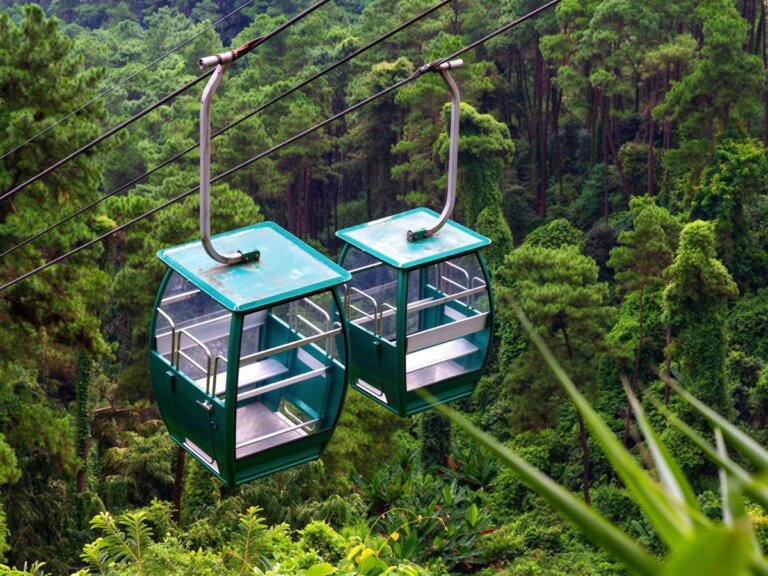
Cable Car and Chairlift
Fixed-grip and detachable chairlifts, sightseeing gondolas and passenger ropeways for moving guests between levels of a site.
 https://www.yuetonrides.com/wp-content/uploads/2026/10/uphill-lift-768×576.jpg
1200 × 900
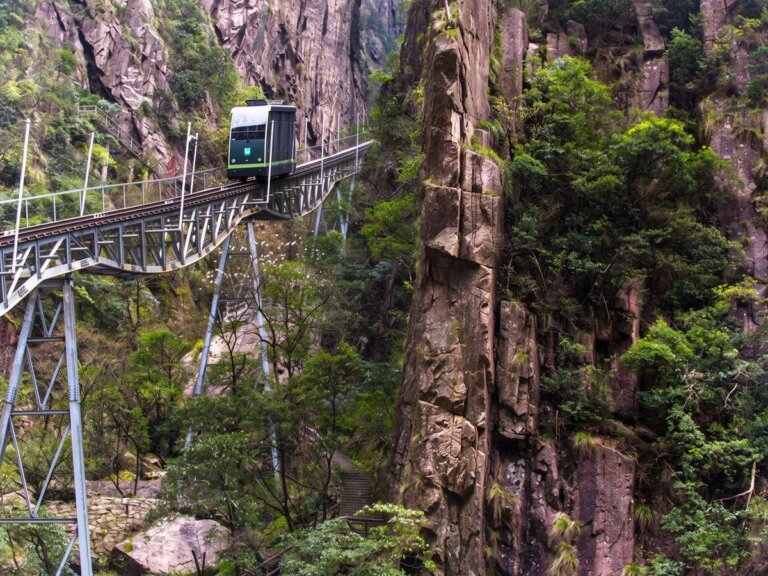
Funicular, Magic Carpet & Themed Rides
Rail car on a cable, continuous conveyor, or a single-rider carrier in animal form. Three ways up a short steep climb, chosen by rise and queue.
 https://www.yuetonrides.com/wp-content/uploads/2026/10/observation-tower-768×576.jpg
1200 × 900
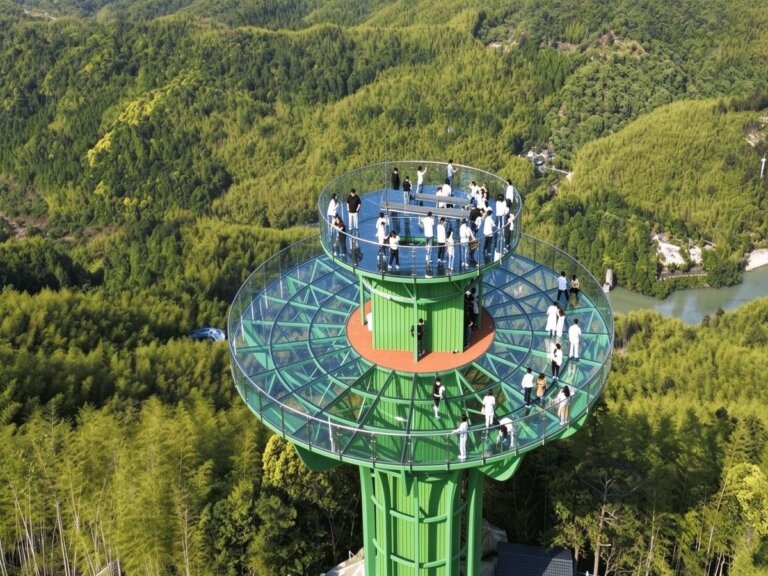
Observation Tower
A fixed tower with a viewing deck, and optionally a slow rotating cabin. Works where the terrain is flat but the view is not.
 https://www.yuetonrides.com/wp-content/uploads/2026/10/glass-bridge-768×576.jpg
1200 × 900
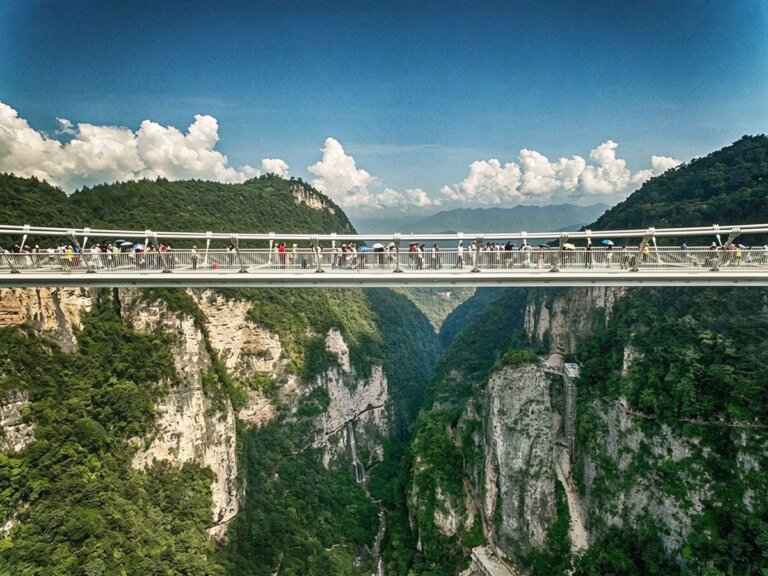
Glass Bridge and Walkway
A transparent deck spanning a gorge or hanging over a slope. Engineering-led: wind, cable dynamics and glass specification decide the design.
 https://www.yuetonrides.com/wp-content/uploads/2026/10/mountain-slide-768×576.jpg
1200 × 900
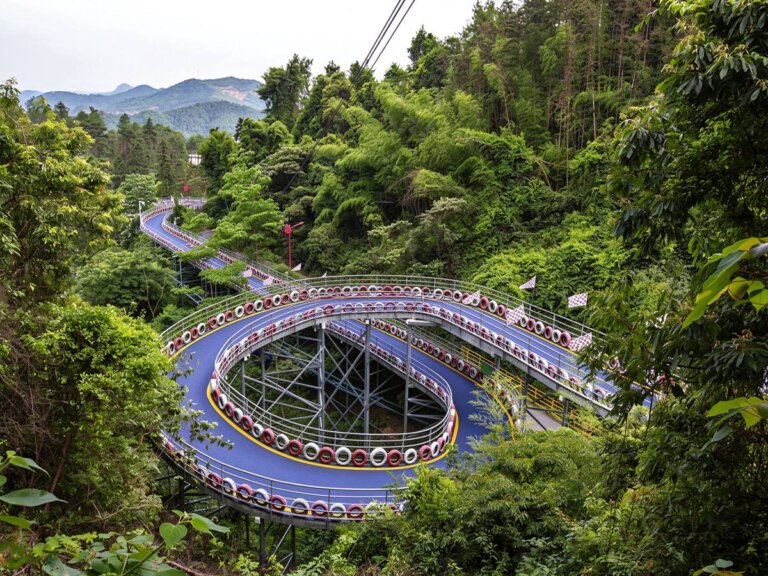
Alpine Slide
A surfaced track down the hillside with rider-controlled sleds. No snow needed, so a ski slope earns revenue in summer. A rail-guided alpine coaster version is also available.
 https://www.yuetonrides.com/wp-content/uploads/2026/10/glass-water-slide-768×576.jpg
1200 × 900
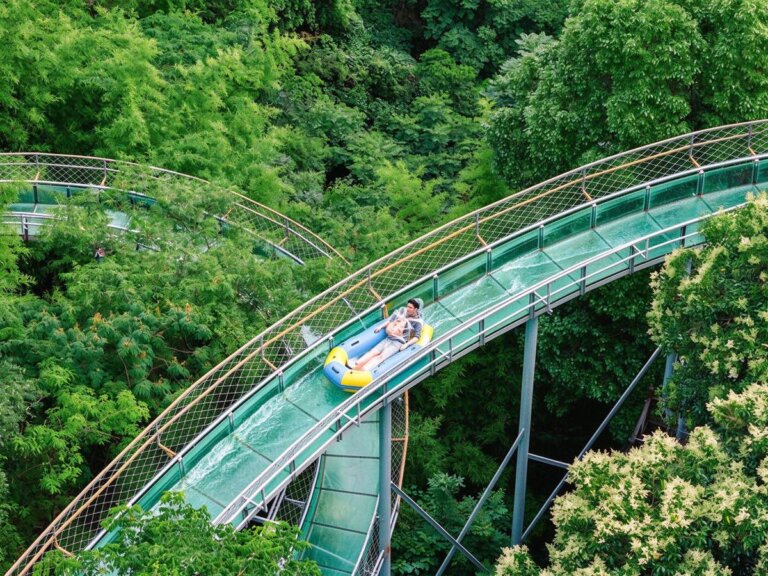
Glass Water Slide
A transparent flume carrying riders down the hillside on a water film. The glass body is the attraction as much as the descent.
 https://www.yuetonrides.com/wp-content/uploads/2026/10/rail-slide-768×576.jpg
1200 × 900
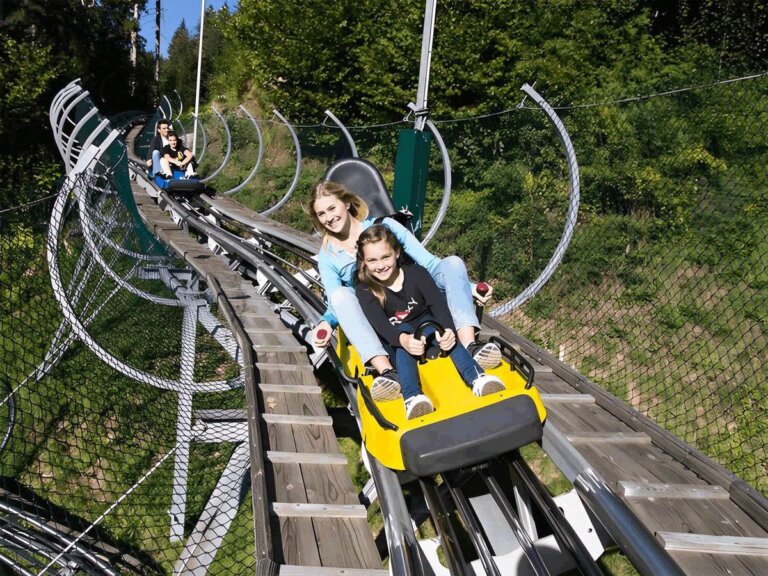
Rail Slide
A stainless steel twin-rail track with individual sleds. Lower capital cost than a coaster, shorter build, and it works on moderate slopes.
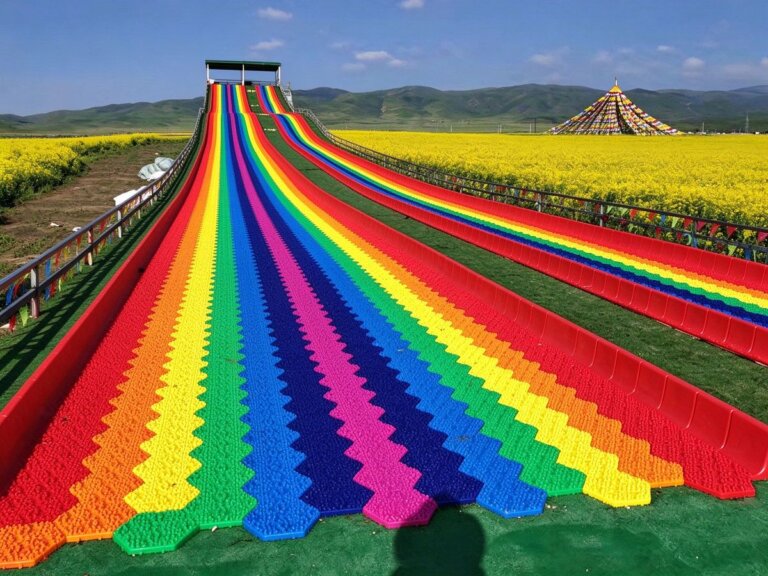 https://www.yuetonrides.com/wp-content/uploads/2026/10/rainbow-slide-768×576.jpg
1200 × 900
Rainbow Slide
Coloured panels down a grass slope, ridden on a ring. The cheapest paid attraction you can add, and the fastest to open.
| Family | Role in the circuit | Vertical drop | Guest flow |
|---|---|---|---|
| Chairlift / ropeway | Uphill access and sightseeing | 50–400 m | 400–2,400 pph |
| Funicular / climbing train | Uphill access on a fixed gradient | 30–300 m | 200–800 pph |
| Magic carpet | Short climbs and station access | 5–40 m | 500–1,200 pph |
| Observation tower | Vertical viewpoint | 30–120 m height | 100–500 |
| Glass bridge / walkway | Horizontal viewpoint | 50–300 m span | 200–1,500 |
| Alpine slide | Downhill experience, year-round | 40–150 m | 300–800 pph |
| Glass water slide | Summer signature descent | 30–150 m | 300–800 pph |
| Rail slide | Low-cost descent | 20–100 m | 150–400 pph |
Ranges above are typical industry values, not a quotation. The same product can differ by several times across sites, so final figures are confirmed against the model sheet after the site survey.
Choosing by terrain and guest flow
The site decides the product far more than the budget does.
| Site condition | Recommended | Reason |
|---|---|---|
| Steep forested slope, dry climate | Alpine slide | Long descent without water supply; runs in shoulder season and on dry ground. |
| Steep slope with reliable water and drainage | Glass water slide | The water film carries the ride; transparent flume becomes the visual draw. |
| Moderate slope, tight budget, short season | Rail slide | Lowest capital cost per metre, fastest to build, simplest to operate. |
| Long horizontal distance, high guest volume | Chairlift or gondola | Moving guests is a throughput problem, not a thrill problem. |
| Short, steep climb where a lift tower is not permitted | Funicular / climbing train | Rail-mounted and compact; easier to approve than a ropeway in a protected skyline. |
| Short climb, or the return leg of a sled track | Magic carpet | A conveyor does the job at a fraction of the cost of a lift, with almost no maintenance. |
| Flat terrain with a long view | Observation tower | Where there is no slope to build on, height has to be manufactured. |
| Gorge, valley or cliff edge | Glass bridge or walkway | The span is the attraction; engineering is carried by cables and deck, not by terrain. |
| Existing ski resort, empty summer | Alpine slide + rail slide | Reuses the lift, the access road and the existing visitor base. |
| Flat site without usable gradient | Not this family | A slope-based product on flat ground is a maintenance cost with no experience. |
Typical configurations by site size
Three profiles we quote most often. Use them to sanity-check a budget before the survey.
| Site profile | Typical circuit | Drop / span | Design guests per day |
|---|---|---|---|
| Small hill park under 20 ha, summer season only | Magic carpet + alpine slide, optionally a short glass flume | 40–60 m drop 600–900 m track | 800–1,200 |
| Mountain resort existing lift, empty in summer | Alpine coaster + rail slide, reusing the lift and access road | 80–120 m drop 1,000–1,400 m track | 1,500–2,500 |
| Gorge or cliff site no usable slope, high footfall | Glass bridge + observation tower + gondola for access | 120–200 m span 60–90 m tower | 3,000–5,000 |
Guests per day is a design figure at peak season, not a forecast. It sets the capacity of the lift and therefore the length of every queue behind it.
What a complete installation includes
Six stages. Most delays in this industry happen in stages one and four, not in the factory.
Site survey and feasibility
Topographic survey, soil and foundation check, access route, wind and drainage. Output: whether the site can carry the product at all.
Engineering and drawings
Alignment, profile, support spacing, station layout, foundation loads. Output: stamped drawings and a bill of quantities.
Manufacture
Track or flume sections, supports, vehicles, control system. Factory acceptance before packing.
Civil works and logistics
Foundations, station buildings, water supply where applicable, shipping and customs. This is where schedules usually slip.
Installation and commissioning
Assembly, alignment, load testing, empty and manned test runs, control system handover.
Operation and spares
Operator training, maintenance schedule, spare parts package, remote support.
Why work with Yueton
A factory that also builds the site, rather than a trader that forwards your drawings.
Engineering before quoting
We ask for coordinates, slope and guest forecasts first. A quote without a site profile is a number you cannot build on.
Own production, own installers
Tracks, structures and vehicles are made in our own plant; installation is done by our own crews, not subcontracted locally.
Export experience since 2008
Park and attraction projects delivered in more than 20 countries, with export packing, documentation and on-site commissioning.
Site-specific, not catalogue-specific
Length, drop and station position follow your terrain. The model sheet is the starting point, not the answer.
Project experience
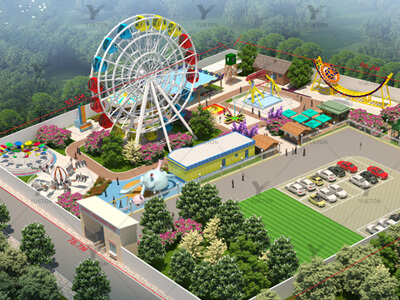
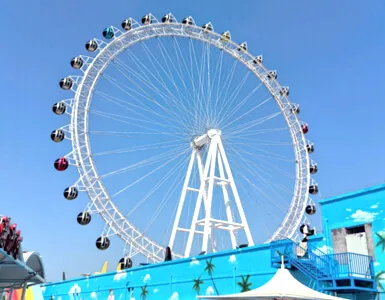
Yueton has delivered amusement and attraction projects in Chile, Indonesia, Nepal, Kazakhstan, Kyrgyzstan, Libya, Tanzania and other markets — ferris wheels, coasters, carousels and trackless trains, installed and commissioned by our own teams. The same engineering and installation organisation now handles scenic-area equipment.
Frequently asked questions
What is scenic area equipment?
It is the hardware installed inside a scenic area or mountain resort to create a visitable experience: downhill tracks such as alpine slides and rail slides, water flumes such as glass water slides, and uphill transport such as chairlifts and ropeways. It differs from park rides because the product has to be engineered to the terrain rather than assembled on a flat concrete slab.
How much does a scenic area installation cost?
Cost splits into four parts: equipment, civil works and foundations, installation, and freight. Equipment is usually the largest single line, but on steep sites the civil works can approach it. We quote after the site survey, because the same product on two different mountains can differ by a factor of two or more. A budget band can be issued earlier from coordinates and a guest forecast.
How long does delivery take?
Slide-type equipment typically runs 30–150 days from approved drawings. Installation adds 45–90 days on site, depending on access roads, weather window and whether foundations are ready when the containers arrive.
Can you work from our own survey?
Yes, and it shortens the schedule. We need topographic data, soil bearing capacity, the access route for containers, and the intended operating season. If the survey is incomplete we can arrange one, or work from satellite data and a site visit for a preliminary alignment.
What certifications are available?
Requirements depend on the country and on the equipment type — cable-propelled passenger transport is regulated differently from a gravity track in most jurisdictions. We confirm the applicable standard with you during the feasibility stage and state exactly what is and is not covered before the contract, rather than listing certificates that may not apply to your market.
Do you install on site?
Yes. Installation and commissioning are carried out by our own engineering team, with operator training and a spare parts package included. For remote sites we also offer a supervision model where a local contractor performs the civil works under our technical direction.
Can you plan the whole circuit, not just one product?
Yes, and it is the better way to buy. Capacity at the top decides queue length at the bottom, and the descent has to land where the lift can pick guests up again. When the three parts are designed together, one station serves two products and the route works on paper before it is built on the mountain.
Can the equipment run all year?
Alpine slides and rail slides run without snow and can operate across three seasons; glass water slides are limited by water temperature and frost. Cable cars and glass structures are the most weather-dependent. The operating calendar is part of the feasibility study, because it drives the payback calculation more than the ticket price does.
Get a quote for your scenic project
Send us the coordinates, the usable slope and your expected daily guests. We will come back with a product recommendation, an indicative budget band and a schedule — before any drawings are made.