


Funicular, Magic Carpet and Themed Uphill Rides
Three ways to move guests up a short, steep climb: a rail car on a cable, a continuous conveyor belt, and a single-rider themed carrier on a guided track. Rise 5–300 m, capacity 200–1,200 people per hour. The right one is decided by height gained and how many people are waiting at the bottom.
https://www.yuetonrides.com/wp-content/uploads/2026/10/uphill-lift-flume-768×576.jpg
1600 × 900
At a glance
- Funicular — rail car on a cable, 30–300 m rise, 200–800 pph
- Magic carpet — continuous conveyor, 5–40 m rise, 500–1,200 pph
- Themed uphill ride — single rider on a guided track, 100–500 m run, 150–400 pph
- All three are short-climb devices; none competes with a chairlift above 300 m
- Selection is by rise first, then by queue tolerance, then by what the ride is worth as an attraction
Three devices, one job
If you are choosing between them, the answer is almost always in the first two numbers.
Funicular
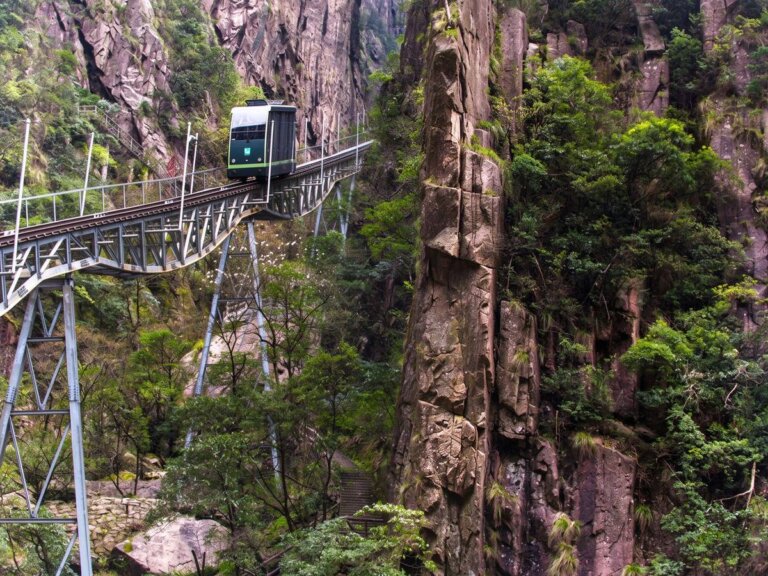
A car on rails, hauled by a cable, counterbalanced by a second car. Handles the steepest gradient of the three and carries seated passengers in weather.
Magic carpet
A conveyor belt on a slope. Guests stand still and the belt does the work. Cheapest per metre, simplest to run, and it never queues.
Themed uphill ride
A saddle carrier — horse, deer or other animal form — running on a guided track and drawn uphill by cable. Slower, lower capacity, and the only one of the three that is an attraction in itself.
Choosing between them
Read down the rise column until you find your site, then check the volume you need to move.
| Funicular | Magic carpet | Themed uphill ride | |
|---|---|---|---|
| Rise | 30–300 m | 5–40 m | Along a 100–500 m run |
| Gradient | Up to ~45% with rack assistance | Typically 10°–20° | Follows the track profile |
| Capacity | 200–800 pph | 500–1,200 pph | 150–400 pph |
| Queue behaviour | Batches — waits for the next car | Continuous — no batch wait | Batches, one rider per carrier |
| Weather | Runs in most conditions | Snow and ice stop it | Runs in most conditions |
| Cost per metre | Highest | Lowest | Middle |
| What it adds beyond transport | Little — it is infrastructure | Nothing — it is a moving walkway | The ride itself is the attraction |
Funicular
The only one of the three that climbs like a lift and sits like a train.
A funicular is two cars on a shared cable, one going up as the other comes down, so the descending car counterbalances most of the ascending load. That is why the drive motor can be small relative to the weight being moved — and why a funicular is economically attractive on a steep, short climb where a chairlift would need towers in awkward ground.
The gradient limit is the design question. Up to roughly 20% a conventional adhesion railway works; beyond that, traction fails in wet or leafy conditions, and the line needs a rack, a chain or a captive-haulage arrangement. Above about 45% the vehicle design changes again — stepped compartments, because passengers cannot stand on a floor that steep. Each of those steps adds cost, so the alignment should be chosen to stay just under a threshold rather than just over one.
Two cars also mean two stations, a passing loop if the line is long, and a tensioning arrangement at the bottom. On lines under about 150 m the whole installation can be remarkably compact; on longer lines the station and loop start to dominate the civil budget.
Magic carpet
The cheapest way up, and the most often specified badly.
A magic carpet is a conveyor belt built into a slope, with a low-friction deck and cleated belt. Guests step on at the bottom, stand still, and step off at the top. Capacity is high because there is no batch cycle — but only if the entry and exit are designed so that people actually keep moving. Most underperforming carpets are not underpowered; they have a bad entry.
The constraints are unglamorous and absolute. Gradient is typically limited to somewhere between 10° and 20°, above which the belt cannot be loaded reliably. Snow and ice stop it, so in a ski resort it needs a covered or cleared line. And the belt needs a proper tensioning take-up at one end and a drive at the other, both of which need maintenance access — which should be part of the design, not discovered afterwards.
Where it earns its place: beginners’ slopes, the return leg of a sled track, station access where stairs would slow the queue, and any short rise under 40 m where a lift would be overkill.
Themed uphill ride
A Chinese-market category with almost no English-language content — and that is an opportunity, not a problem.
This device is well established in Chinese scenic areas and rarely seen in Western markets, which is why there is no settled English name for it. The form is consistent: a single rider straddles a themed carrier — a horse, a deer, a mythological animal — which runs on a guided rail or tube track and is drawn uphill by a cable loop. The rider is carried, not pedalling; the track follows the hillside; the animal shape is the whole point.
Commercially it sits between the other two. It costs more per metre than a conveyor because it has a track, carriers and a haul system, and less than a funicular because it is light, single-track and does not need stations or a counterweight. Capacity is the weak point: one rider per carrier, batched at the bottom, so it suits sites where the queue is part of the experience and the ride is photographed more than it is used for transport.
Its practical advantages are real. The footprint is narrow, so it threads up a slope that has no room for a road or a lift line. The track can follow terrain closely, so earthworks are small. And because it is unusual in export markets, it becomes a differentiator rather than a commodity — visitors do not compare it against a chairlift they have ridden before.
If you are searching for this product in English, the terms that describe it are themed uphill ride, animal-themed rail ride, saddle carrier lift or single-rider uphill track. Ask for it by description rather than by name; there is no standard label in the export market yet.
Technical specification
Indicative ranges. Final values are fixed with the line and track design.
| Parameter | Funicular | Magic carpet | Themed uphill ride |
|---|---|---|---|
| Rise / length | 30–300 m rise | 5–40 m rise, 30–150 m belt | 100–500 m track |
| Gradient | to ~45% with rack | 10°–20° | Track profile, typically 10%–30% |
| Belt / track width | — | 0.6–1.2 m | Single carrier gauge |
| Speed | 2–6 m/s | 0.5–1.2 m/s | 0.8–1.5 m/s |
| Capacity | 200–800 pph | 500–1,200 pph | 150–400 pph |
| Drive | Electric winch, counterbalanced | Geared motor with take-up | Electric winch, cable loop |
| Power | 30–110 kW | 5.5–22 kW | 15–45 kW |
| Lead time | 6–10 months | 40–70 days | 4–7 months |
| Installation | 3–6 months | 2–4 weeks | 2–4 months |
Safety and compliance
Different regimes, same principle: prove the failure case.
A funicular carrying seated passengers is treated as a cable-driven transport installation in most markets, and the approval file needs the brake philosophy, the overspeed detection and the evacuation procedure — including how to bring a car to a station if the drive fails between stops. A magic carpet is usually classified as machinery rather than transport, so the file focuses on guarding at the entry and exit, emergency stop, and belt condition monitoring. A themed uphill ride sits between the two: it carries people, but at low speed and low height, and classification varies by country.
What we do at the start of every project is ask the authority, in writing, what category the installation falls into. It costs a week and saves months, because the documentation set, the inspection body and the operating rules all follow from that single answer.
Cost and schedule
Three very different cost profiles.
Funicular: track, car bodies, winch and cable, stations and civil works. The civil works dominate on short steep lines, because station platforms have to be cut into the slope. Magic carpet: belt, frame, drive and take-up, installation. It is the only one of the three where the civil works can be genuinely minor. Themed uphill ride: track, carriers, haul system, foundations — its advantage is a narrow footprint, which keeps earthworks down, and its disadvantage is carrier count, because capacity comes from more carriers, not from speed.
We do not publish a headline price for any of the three, because access and earthworks move the total more than the hardware does. What we issue is a budget band with the civil assumptions written down separately, so the two can be discussed on their own terms.
Typical configurations
Four situations that cover most enquiries.
| Situation | Recommended | Why |
|---|---|---|
| Beginners’ slope or sled return short, gentle, high volume | Magic carpet, 30–80 m | Continuous flow, no queue, lowest cost per user |
| Steep short cut to a viewpoint 40–120 m rise, no space for towers | Funicular, two cars | Climbs gradients a chairlift cannot follow, minimal footprint |
| Family attraction on a wooded slope limited room, experience matters | Themed uphill ride, 200–400 m | The ride is the product; narrow track threads between trees |
| Service access between levels staff and equipment, low volume | Magic carpet or small funicular | Utility rather than attraction — choose on cost and maintenance |
Maintenance
What each one asks of the operator.
Funicular: cable inspection and tensioning, brake testing, rail and roller condition, station door interlocks. Magic carpet: belt tension and tracking, cleat wear, take-up adjustment, guarding checks — the belt is a wear item and should be budgeted as one. Themed uphill ride: cable and sheave inspection, carrier and saddle condition, track alignment, and a restraint check on every carrier before each session, because a single-rider device lives or dies on its restraint discipline.
Related scenic-area equipment: chairlifts and gondolas for climbs beyond 300 m, alpine slides for the way down, rail slides where the terrain is broken, observation towers where the destination is vertical rather than uphill. A single site survey can cover all of them, because the survey work is the same.
Frequently asked questions
What is the difference between a funicular and a cable car?
A funicular runs on rails and is hauled by a cable, with two cars counterbalancing each other. A cable car or chairlift carries its passengers suspended from an aerial rope. The funicular follows the ground, so it can climb a gradient a suspended lift cannot, and it needs far less height above the surface.
How steep can a funicular go?
Up to roughly 20% a conventional adhesion railway works. Beyond that you need a rack, a chain or captive haulage, and above about 45% the cars need stepped compartments because passengers cannot stand on the floor. Each threshold adds cost, so it pays to design just under one.
What slope does a magic carpet need?
Typically between 10° and 20°. Below that it is usually not worth installing; above it the belt cannot be loaded reliably. Snow and ice will stop it, so a ski-resort installation needs a covered or cleared line.
What is a themed uphill ride called in English?
There is no settled term, because the product is common in China and rare in export markets. The descriptive terms are themed uphill ride, animal-themed rail ride, saddle carrier lift or single-rider uphill track. Ask by description rather than by name.
How much do these cost?
Funicular: track, cars, winch and cable, stations, civil works — the civil works dominate on short steep lines. Magic carpet: belt, frame, drive, installation, with genuinely minor civil works. Themed uphill ride: track, carriers, haul system, foundations; capacity comes from carrier count, which drives cost.
Which one has the highest capacity?
The magic carpet, because it is continuous — there is no batch cycle. A funicular is next, limited by car size and headway. The themed uphill ride is lowest at 150–400 per hour, because it carries one rider per carrier.
Can a magic carpet run in winter?
It can, and it is widely used on beginners’ slopes — but snow and ice must be cleared or covered, and the belt needs to stay free of build-up at the drive and take-up. In exposed sites this becomes a daily operational task rather than an occasional one.
How long does installation take?
Magic carpet: 2–4 weeks, the fastest of the three. Themed uphill ride: 2–4 months. Funicular: 3–6 months, with station civil works usually on the critical path rather than the hardware.
Tell us the rise and the queue, we will tell you which one
Height gained, expected guests per hour and the space available at the bottom are enough for a first recommendation — with an indicative budget band for each of the three.